
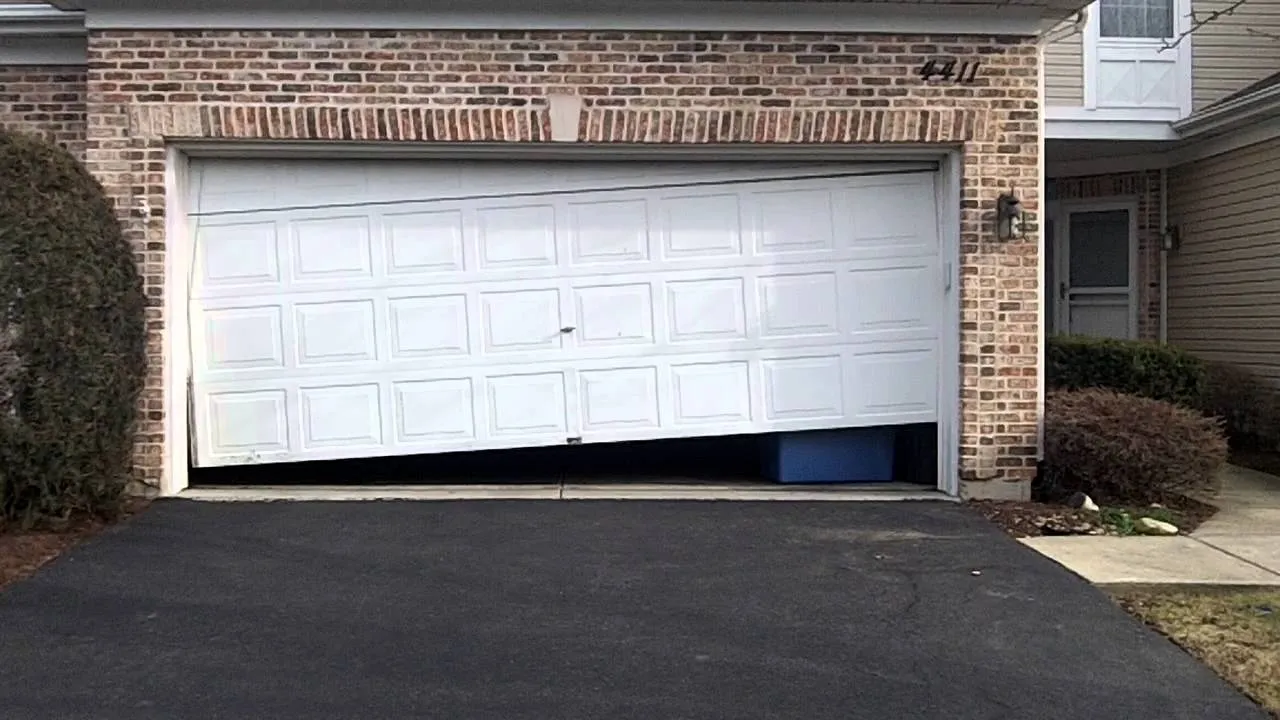
A crooked overhead door can indicate a problem with its lifting hardware, tracks, rollers, or door sections. If one side rises ahead of the other, the door hangs at an angle, or movement suddenly becomes uneven, stop operating it and arrange professional inspection.
Repeatedly pressing the control is not a useful test when the door is visibly misaligned. Keep people, vehicles, and equipment away from the opening, particularly when the door is partly raised.
This guide explains what a crooked overhead door may be telling you, which observations help a technician, and how to evaluate the proposed repair without attempting tension-system adjustments yourself.
Is the Door Crooked, or Is the Floor Uneven?
A gap beneath one corner does not always mean the door itself is traveling crooked. The floor, bottom seal, door position, and alignment all need consideration.
A crooked overhead door may show uneven movement, while an uneven floor can create an unequal gap beneath a door that otherwise sits square. Appearance at one position cannot settle the distinction.
Tell the technician whether the issue is a floor-level gap or movement you already observed. Do not run a visibly damaged door again just to provide a demonstration.
What Should You Photograph?
From a safe position, capture the whole opening and the visible gap. Include the surrounding frame and floor rather than only a close-up of the bottom seal.
For a crooked overhead door, these wider images provide context. They cannot verify the condition of hidden hardware or establish whether the system is safe to move.
Why Does a Crooked Overhead Door Lift Unevenly?
A sectional door depends on coordinated movement at both sides. A fault affecting lifting or guidance can cause one corner to move differently from the other.
A crooked overhead door therefore needs a system inspection rather than an automatic assumption that the opener is weak. The visible tilt describes the symptom, not the failed component.
Record what happened before movement became uneven. A sudden noise, impact, obstruction, or earlier repair may help the technician decide where to investigate first.
Why Should You Stop Cycling the Door?
A door that is already misaligned needs assessment before further operation. Repeated attempts can complicate the condition and expose people or equipment to an unstable opening.
Treat a crooked overhead door as unavailable until it has been evaluated. If access is essential, explain that to the service company rather than trying to create a temporary path beneath it.
Could Cable Damage Cause a Crooked Overhead Door?
Cable issues are one possible explanation for uneven lifting. A cable may appear frayed, loose, displaced, or visibly different from its counterpart.
However, a crooked overhead door should not be diagnosed from cable appearance alone. The technician needs to determine both the cable’s condition and whether another problem contributed to it.
Observe from a safe distance without pulling, reseating, or tightening anything. Parts associated with the lifting system can be under significant tension.
Does a Loose Cable Simply Need Tightening?
Not necessarily. An adjustment made without understanding the door’s condition can leave the underlying issue unresolved.
For a crooked overhead door, cable work should follow a complete assessment of the relevant system. Request an explanation of the identified fault and any associated damage before approving the repair.
Can a Broken Spring Cause a Crooked Overhead Door?
The counterbalance system helps manage the door’s weight. Spring-related faults can affect balance and movement, but the symptoms depend on the door’s design and condition.
A crooked overhead door may need spring evaluation even if the opener still responds. Motor noise or partial movement does not establish that the door is properly balanced.
Report a loud bang if one occurred, but avoid deciding that it proves a spring failure. Similar observations can require different follow-up checks.
Should You Replace the Opener First?
Replacing an opener without evaluating the door may miss the reason it is struggling. The mechanical condition and the powered operator should be assessed as related parts of the installation.
When inspecting a crooked overhead door, the technician should distinguish the original fault from any additional damage. Ask which findings support the recommended component replacements.
What If a Roller Is Outside the Track?
A visibly displaced roller is a reason to keep the door out of use. The inspection should establish how it became displaced and what other parts were affected.
A crooked overhead door with a roller issue may also have damaged hinges, sections, or track components. Putting one visible part back does not establish that the complete system is ready to operate.
Do not hammer the track, pull on the panel, or try to push a roller back into place. Leave the assembly undisturbed for professional assessment.
Could Bent Tracks Explain a Crooked Overhead Door?
Tracks guide the door, so their condition and alignment matter. Damage following vehicle or equipment contact is particularly useful information to share.
With a crooked overhead door, ask the technician to evaluate the track alongside rollers, hardware, and mounting conditions. A single bent-looking area may not describe the complete repair.
Photograph visible impact damage from a safe location. Include when it happened and whether the door was operated afterward.
Is Straightening the Track Always Enough?
The appropriate response depends on the component and the extent of damage. Some situations may require replacement or associated repairs rather than a simple adjustment.
For a crooked overhead door, the proposed scope should explain which parts remain suitable to retain. A repair should address the cause of binding as well as the obvious mark.
Could a Damaged Panel Make the Door Look Crooked?
A bent or distorted section can change the appearance and operation of a sectional door. Damage may also affect the locations where hardware attaches.
A crooked overhead door after an impact deserves inspection beyond the visible dent. The technician should assess the affected section and its relationship to adjoining parts.
Do not assume a cosmetic repair and a functional repair are interchangeable. Ask whether the section can remain, requires replacement, or forms part of a broader replacement recommendation.
Is the Problem Just the Safety Sensors?
A door that refuses to close can have a control or safety-system issue. That is a different symptom from a door visibly hanging at an angle.
For a crooked overhead door, cleaning a sensor or changing a remote battery does not address the mechanical misalignment. Avoid treating every closing problem as a sensor fault.
Report error messages or indicator behavior if already visible, but do not bypass safety devices. The technician can assess the operating system after establishing the condition of the door.
Should You Pull the Emergency Release?
Do not use an emergency release as a shortcut to move a visibly damaged or partly open door. Disconnecting the operator is not a repair and can change how the door is supported.
For a crooked overhead door, leave manual operation and release decisions to the responding technician. Explain the current door position when requesting service.
The same caution applies to manually pulling one corner downward or lifting the other side. A door that needs repair should not be leveled by improvised force.
What Should a Business Do While the Door Is Unavailable?
At a commercial or industrial property, an unusable opening affects more than convenience. Employees, delivery drivers, and equipment operators need clear instructions about the affected area.
Keep a crooked overhead door out of the traffic plan and arrange an alternative route where one is available. Do not send staff beneath a damaged, partly raised door.
Tell the repair company about the door’s size, current position, building use, and access restrictions. Explain any security concern so the technician can advise on the appropriate service response.
Preserve Useful Information Without Creating Another Hazard
Keep existing photographs, impact reports, and previous service records accessible. Note when the problem began and whether it followed a particular event.
For a crooked overhead door, documentation is more useful than repeated demonstrations. The technician can decide how to inspect and test the system safely.
What Do Different Symptoms Suggest?
Use symptoms to organize the service request rather than to select parts yourself. Several faults can produce similar behavior.
| Observation | Areas a technician may investigate | What to do meanwhile |
|---|---|---|
| One corner sits higher during movement | Lifting hardware, balance, and guidance | Stop operation |
| Door hangs at an angle with visible cable damage | Cables and associated lifting components | Keep clear and arrange service |
| Roller appears displaced | Roller, hinge, track, and section condition | Do not attempt reinsertion |
| Tilt begins after an impact | Panels, tracks, mounts, and hardware | Report the impact history |
| Unequal floor gap without known uneven movement | Floor, seal, and door alignment | Request assessment rather than assume a cable fault |
| Operator responds but door binds | Mechanical resistance and operator condition | Avoid repeated control inputs |
A crooked overhead door can involve more than one item in this table. The inspection should connect the observed symptoms with verified findings.
What Should a Crooked Overhead Door Inspection Cover?
The inspection needs to match the door type and fault. A sectional system should not be treated as identical to every rolling steel or other commercial door.
For a crooked overhead door, discuss the lifting system, guidance components, section condition, attachment points, and operator where applicable.
Ask the technician to explain what failed, what may have contributed, and which additional parts were checked. This makes the proposed scope easier to evaluate.
If a component was replaced recently, provide the service record. The timing may be relevant, although it does not prove that the earlier repair caused the current problem.
Does a Crooked Door Need Complete Replacement?
Not automatically. A suitable component repair may restore the installation when the remaining door and hardware are in appropriate condition.
A crooked overhead door may justify broader replacement when damage is extensive, compatible parts are unavailable, or retaining the existing system is impractical.
Compare the repair and replacement scopes on the same basis. Consider included components, associated damage, operational needs, and the condition of retained parts rather than comparing totals alone.
What Affects Crooked Overhead Door Repair Costs?
The failed component is only part of the estimate. Door size, configuration, access, associated damage, parts availability, and the work needed to restore operation can all affect the scope.
A quote for a crooked overhead door should identify the diagnosed problem and proposed correction. Clarify which parts, labor, and testing are included.
Ask how additional findings will be documented before extra work proceeds. A photograph may support initial planning, but a reliable final scope often requires on-site inspection.
What Should Be Checked After Crooked Overhead Door Repairs?
Repair completion should include the relevant operating and safety checks for the actual system. A door that looks level in one photograph has not necessarily been fully evaluated.
After a crooked overhead door is repaired, request a summary of the work and any remaining recommendations. Confirm who has cleared it for normal operation.
For businesses, share that update with the people responsible for operating the opening. Keep the service record with the door’s maintenance information.
Frequently Asked Questions
Can a Crooked Overhead Door Fall?
A visibly misaligned or damaged door should be treated as potentially unstable. Keep clear, stop operating it, and have a professional assess its condition rather than assuming it will remain where it is.
Why Is There Daylight Under Only One Corner?
Possible explanations include the floor, bottom seal, or door alignment. Tell the technician whether you previously observed uneven travel; the floor-level gap alone does not establish the cause.
Can Lubrication Straighten an Uneven Door?
Lubrication is not a correction for a displaced roller, damaged cable, broken component, or other alignment fault. Identify the problem before treating it as a routine maintenance issue.
Should I Keep the Button Pressed to Close It?
Do not force a malfunctioning door to operate or override its protective functions. Stop using the opening and report its current position when arranging repair.
Is a Crooked Overhead Door Always a Cable Problem?
No. Cables are one possibility, but tracks, rollers, springs, sections, and related components may need evaluation. The repair should follow inspection findings rather than a single symptom.
Can I Move My Car Under a Partly Open Door?
Do not pass beneath a visibly damaged or unstable door. Tell the service company that a vehicle is blocked and arrange a safe professional response.
Does a Commercial Door Need a Different Repair Approach?
The approach depends on its type, size, configuration, and operating equipment. Provide those details when booking service so the response suits the actual installation.
Will Replacing One Part Prevent Every Future Problem?
No repair can guarantee that unrelated components will never fail. A complete inspection can identify additional concerns and support a maintenance plan suited to the door’s use.
What Should I Tell the Technician on the Phone?
Describe the door’s current position, the uneven movement already observed, any impact or unusual noise, and visible damage. Mention blocked access or security concerns without operating the door again.
How Can I Reduce the Risk of Another Crooked Overhead Door?
Follow the applicable maintenance recommendations, report changes in movement, and address impact damage promptly. Keep service records and avoid continuing operation after a clear mechanical change.
Resolve Uneven Movement Before Returning the Door to Service
A crooked overhead door is a reason to stop and investigate. The repair should establish why the door became uneven and address associated damage rather than simply make it appear level.
Keep the opening clear, document what you already observed, and let a qualified technician assess the mechanical and operating systems. Clear findings make repair decisions easier to understand.
J’s Overhead Door LLC provides overhead door repairs, including work on broken springs, damaged panels, malfunctioning openers, and off-track doors. Property owners in Sterling Heights, Michigan, can call (586) 422-3523 to describe the problem and arrange service.